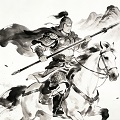
Was Zhuge Liang really that brilliant?
Zhuge Liang (181–234 CE), who served as chancellor of the Shu Han state during China’s Three Kingdoms period, is often shown in popular stories as a strategist with almost magical powers.

Zhuge Liang (181–234 CE), who served as chancellor of the Shu Han state during China’s Three Kingdoms period, is often shown in popular stories as a strategist with almost magical powers, someone who could predict the weather, outsmart his enemies with perfect plans, and carry out complicated military operations as if he had supernatural insight—but the real question is whether he actually had these abilities or if later writers simply made him seem far more impressive than he really was.
I. The Real Zhuge Liang: A Smart Leader, but Still Human
Historical sources—especially Chen Shou’sRecords of the Three Kingdoms Sanguozhi)—describe Zhuge Liang not as an all-knowing genius but as a serious, honest, and highly capable official who worked hard to keep Shu Han stable after Liu Bei’s death by fixing laws, improving the economy, and making sure the government functioned well even though the state had very limited resources.
Although he led five northern campaigns against the rival Wei kingdom, none of them ended in major victories because his armies often struggled with supply shortages, his approach to warfare was careful to the point of being slow, and strong defenses led by generals like Sima Yi repeatedly blocked his advances; one of his biggest errors was putting too much trust in Ma Su, whose defeat at Jieting in 228 CE ruined a key offensive and clearly showed that Zhuge Liang, like everyone else, could make serious mistakes.
So while he was clearly intelligent and effective in many ways, historical evidence shows he was not the flawless mastermind that later tales would suggest.
II. The Legendary Zhuge Liang: How Stories Made Him Seem Magical
As time passed, people began telling more dramatic and exaggerated stories about Zhuge Liang, and by the 14th century, Luo Guanzhong’s famous novelRomance of the Three Kingdoms turned him into a near-mythical figure who could do things that seemed impossible—such as calling on the east wind to set enemy ships ablaze during the Battle of Red Cliffs, correctly forecasting solar or lunar events to boost or shake troop morale, creating a confusing “Stone Sentinel Maze” that trapped pursuers, or faking his own death just so his army could retreat safely.
These exciting scenes are not found in reliable historical records but were added to highlight values like loyalty, wisdom, and moral strength that were important in Confucian thought, and they also borrowed ideas from Daoism and Buddhism; over generations, this storytelling transformed Zhuge Liang into a cultural symbol—the ideal wise minister who used his mind not for personal gain but for the good of his ruler and country.
III. What Experts Say Today: Separating Truth from Tale
Most historians now agree that Zhuge Liang’s godlike reputation comes mostly from fiction rather than facts, and scholars such as Rafe de Crespigny have pointed out that his real talent lay in running a government smoothly rather than winning battles through clever tricks; military analysts also note that his actual strategies were practical and cautious, not flashy or prophetic like the ones shown in novels.
In addition, research on how societies remember heroes shows that people often give great leaders superhuman qualities to pass down moral lessons, and in Zhuge Liang’s case, his lifelong loyalty to Liu Bei’s cause—even when it was clear Shu Han was losing—made him a powerful example of duty, honesty, and perseverance in Chinese tradition.
IV. Conclusion: Great, but Not Perfect
Zhuge Liang was without a doubt one of the most skilled and thoughtful leaders of his era, and his work in law, finance, and long-term planning left a real mark—but calling him a “divine calculator” gives a false impression because he faced real limits, made real errors, and sometimes failed despite his best efforts.
His lasting importance does not come from magic or perfect prediction but from ordinary human strengths: he stayed true to his word, kept working hard no matter how tough things got, and never abandoned what he believed was right, even when success looked unlikely—and that is why he still inspires people today, not because he was beyond human reach, but because he showed what a person can achieve through character, effort, and principle.
As a well-known line fromRomance of the Three Kingdoms puts it:
“Plans are shaped by human effort; their success rests with Heaven.”
Perhaps no one lived by that idea more fully than Zhuge Liang himself.